
The world is in the middle of a new farming revolution, flared by the implementation of cutting-edge technologies. Thanks to precision agriculture, a unified system that strives to balance out the shortcomings of traditional farming and combat hunger due to the disparity between the ever-increasing food demand and agricultural growth.
But what is precision agriculture, and how can it help us make the world a better place for future generations, ensuring food, economic and environmental sustainability?
To know more about this newly-practised efficient framing technology, read on.
What is Precision Agriculture?
Precision agriculture is a set of methodologies and integrated avant-garde technologies like sensors, AI, robotics, and more that help farmers improve and optimise overall farm productivity growth, implementing a chain of targeted key interventions and augmenting the decision-making process. The aim is to streamline and automate the input management process in the land acting based on the crop condition.
Precision agriculture, with a whole host of data, help cultivators to:
- Get actionable insights and data analytics on the crop requirements
- Keep track of the farm activities and the livestock animals
- Take realistic and data-driven decisions
- Have greater real-time livestock traceability and more
According to research conducted by the European Parliament, in 2016, the percentage of farmers in the EU using technologies, including precision tech, was around 25%. Although the technology adoption rate was lower in 2016, it is surging recently. The global precision agriculture market size was 6,457 million dollars in 2020 and is forecast to reach 23,056 million dollars by 2030, rising at a CAGR of a staggering 13.4% during the projection period 2020-2030.
Difference Between Precision Agriculture and Sustainable Agriculture
Agricultural sustainability is the process of using crops, food, and livestock to ensure food security worldwide, causing no/minimum environmental damage. On the other hand, precision agriculture technologies enable farmers to contribute to agricultural sustainability by automating farming operations and producing more crops.
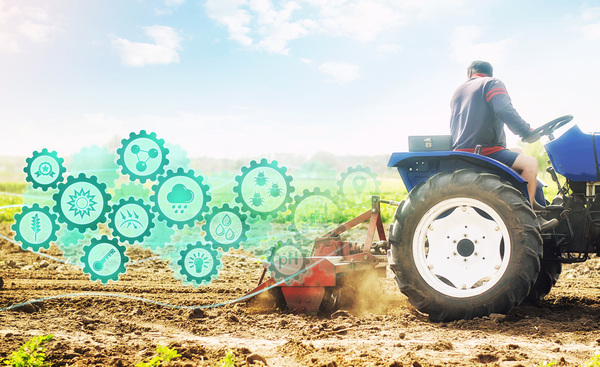
Precision Agriculture Technologies
GPS
It is tough to predict exactly what precision farming would look like without GPS today. From the time scientists could successfully employ locating satellites for agricultural purposes in the mid-1990s, industrialists and operators had unveiled myriad possibilities to tie into satellite technology and GPS devices to streamline and manage farmwork more effortlessly and precisely. The outcome is the use of GPS in precision farming is forecast to skyrocket shortly.
The use of GPS in precision agriculture include:
- Precision Ploughing: Coupling with auto-steer and advanced data-driven guidance system, GPS enables cultivators to place furrows in the land with just a millimetre precision – ploughing had never been so effortless and accurate before.
- Planting and Fertilisation: GPS data has been proven to be highly efficient in helping farmers sow seeds within the furrows. Thus, the process becomes more accurate and less time-consuming, and seed wastage decreases to a great extent. Further, GPS information can be used to locate nutrient-deficient land portions and apply fertilisers at the right place, at the right time, and in the right amount.
- GPS-enabled modern data acquisition devices help crop advisors map and pinpoint weed infestations and pests most accurately. Plus, any historic field data can be used by aircraft sprayers for prompt field swathing and management without really involving human ‘flaggers’.
- Instantaneous Yield Monitoring Systems: Yield tracking devices, integrating GPS and mass flow sensors, enable farmers to monitor field yield and gauge the crop weight without undergoing the tedious manual process. This precisely tracked yield data can be used for future site-specific land preparation.
Sensor-based technology
Thanks to today’s sophisticated sensor-based technology that helps farmers automate data collection and analytics about all essential crop production parameters – from soil moisture content, soil fertility, and leaf area index and temperature to climate condition.
Let’s have a quick overview of different types of sensors that can make farms operate more efficiently:
- By detecting, monitoring, mapping, and analysing ions like Potassium, Sodium, Phosphorous, Copper, Calcium, Nitrogen, and Iron, electrochemical sensors offer essential soil chemical information, including pH and soil nutrient levels – two catalysts to eco-friendly and sustainable food production while bolstering revenue.
- Optical sensors, by measuring and analysing the wavelength of the light reflected from the soil and crop growing parts, help farmers get better insights into soil attributes. The analysed properties can be soil water content, soil constituents, required nitrogen level in the soil for optimal plant growth, biomass/nitrogen ratio to other gases, and more. The light can be emitted by installing sensors on drones, aeroplanes, UAVs, etc.
- Air Flow Sensors: This type of sensor enables farms to measure and track the soil attributes, gaseous substances, and water permeability of the soil and aerate the land after irrigation for an efficient seeding process.
- Dielectric sensors, operating based on the dielectric constant of the soil, can measure and record the soil moisture levels in real-time and provide data on the crop root zone, evaporation rate, soil nature, and more. Thus the cultivators can better optimise and streamline the irrigation monitoring and control process.
Robots/Farm Automation
Farm robots have made incredible strides over the last couple of decades by enabling farmers to work smarter, not harder.
Though new, the number of companies trying to turn into ‘smart farms’ is skyrocketing recently. The benefits are many: reduced production cost and human-made errors, repetitive task automation, augmented decision making, increased crop yield and revenue, and the list goes on.
The most used farm automation technologies in precision agriculture are:
- Harvest automation machines
- Automated Tractors
- Agricultural machinery
- Irrigation drones
- Weed management and seeding
- Autonomous trimming, mowing, and spraying
Benefits of Precision Agriculture by Maximising Technologies
Precision agriculture, with a whole host of data, help cultivators to:
- Get actionable insights into the crop requirements.
- Keep track of the farm activities and have greater real-time livestock traceability.
- Take realistic and data-driven decisions.
The other benefits include:
- Innovative technologies like Artificial Intelligence, Machine Learning, and IoT make agronomic modelling, big data acquisition, and analytics using predictive models effortless – the result is a subsequent reduction in crop production and maintenance costs.
- RFID/’tagging technology’ used in precision farming helps maintain the freshness of the products across the entire agricultural supply chain.
- Facilitates livestock monitoring and disease detection in animals for immediate action in the event of an outbreak
- Precision agriculture makes farms operate based on agronomic principles for higher crop yields and increased profitability.
- Precision farming enables farmers to set up parameters for optimal crop growth to ensure better crop quality.
- Ensures efficient water allocation and less runoff of toxic chemicals into the river and groundwater
- Employing AI-driven robots and drones/aircraft for weed control, pesticide spraying, and more reduces crop loss, ensures efficient chemical use, etc.
Challenges in Precision Agriculture
- Turning a traditional farm into a smart one is a long-term investment that involves high initial capital costs.
- Farms may require several years for a fully-functional automated system as some technologies integrated into precision agriculture operate based on historic data and tests.

Joel Stokes is the founder of Agrisurfer, a leading blog dedicated to exploring the intersection of technology and farming. With a deep passion for innovation in agriculture, Joel and his team of experts provide in-depth analysis and insights on everything from high-tech machinery to drone surveillance for livestock.